| Adapted for the Internet from: Why God Doesn't Exist |
| Pastor Al’s ‘water sprinkler’ theory of light |
1.0 The problem
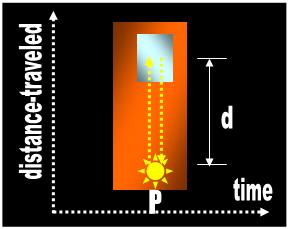
In another acclaimed thought experiment relating to time dilation, a passenger shines his flashlight in a
mirror of a moving boxcar as illustrated in Fig. 1. According to relativists, light from the flashlight travels a
distance d, reflects in the mirror, and backtracks, reaching the passenger at P. Since the mirror and the
flashlight are moving with the boxcar, the passenger is not aware of any lateral motion of the beam of light.
Therefore, he calculates the time for the round-trip beam traveling at the velocity of light c to be:
- This is straight forward distance-traveled. You throw the ball directly at the wall and it bounces back. The
ball covered the distance to the wall twice.
Fig. 1 The mirror and the flashlight |
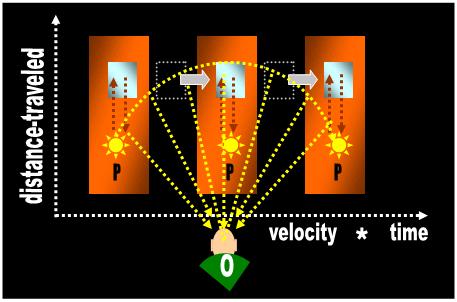
According to Einstein, however, a distant stationary observer arrives at a different conclusion. The reason for
this is that the boxcar together with the passenger is moving past him at near-c. Therefore, the particles of light
do not simply go forward and back. The photons describe an arc in space (Fig. 2).
Fig. 2 The distant observer’s perspective |
For the mathematically inclined, let’s also briefly review the relativistic math behind these claims. Imagine
throwing a ball up in the air inside a moving car. If the pitcher is to catch it again, the ball could not have
merely gone up and down. It must have described an arc in space to account for the motion of the car.
This is what the distant observer sees. Therefore, he calculates the time it took the photon to do the
round-trip a little differently than the passenger:
- where TimeP is the amount of time measured by the passenger
and TimeO is the amount of time measured by the distant stationary observer.
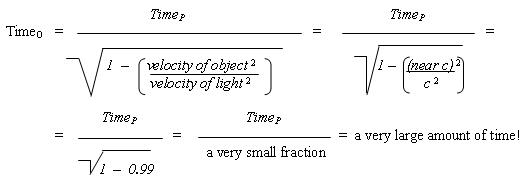
Therefore, if the object travels at near-c, Time0 is much greater than TimeP:
As with length contraction and mass increase, the mathematicians encounter paradox when they plug
extreme values into the equation. As the boxcar approaches the speed of light, the amount of time it takes
for the observer to receive the signal approaches eternity. At exactly the speed of light, the denominator
goes to 0 and the numerator is in God’s hands. The signal never reaches our observer and he might as
well be in heaven. Under these circumstances, our mathematicians prefer to tell the layman that time is
‘undefined’ (whatever that means). This realization led Einstein to conclude that matter cannot travel at
the speed of light. If it did, we could not give a rational physical interpretation to the equation.
2.0 Math versus Phyz
Again we have differences between Mathematics and Physics. A ball thrown inside a moving car either
travels ‘straight’ up and down or describes an arc, it can’t be both. If the passenger in his frame of
reference is unaware of this phenomenon, the passenger is simply wrong. What he perceives or believes
is irrelevant in Physics. It only has importance to relativists, who exclaim with ignorant pride that relativity
allows everyone to have diametrical opinions and also be right. The question in Einstein’s gedanken
experiment is whether the distant observer is correct. Did light describe an arc in space?
Einstein was obsessed with curvilinear trajectories and could never come around to believe that light
travels ‘straight’. This is the source of his downfall. He died without hope, without understanding anything
about the Universe. He believed that space was warped and that light traveled along this curved ‘surface’.
In 1919, in reference to Eddington’s alleged confirmation of his theory, he remarked that his theory was
correct. However, he wasn’t as cocky by the time he died, writing to his friend Besso in 1954 that:
- “ All these fifty years of conscious brooding have brought me no nearer to the
answer to the question, ‘What are light quanta?’ Nowadays every Tom, Dick
and Harry thinks he knows it, but he is mistaken. … I consider it quite possible
that physics cannot be based on the field concept, i.e., on continuous structures.
In that case, nothing remains of my entire castle in the air, gravitation theory
included, [and of] the rest of modern physics.” (p. 467) [1]
- His disciples fail to see the painful lesson a lonely Einstein learned before he died. They regard his tenure
at Princeton as the last days of a senile old man out of touch with science. Of course, the common folk out
there aren’t particularly aware of this and continue to treat the name Einstein as a synonym of intelligence.
In one of his ludicrous gedanken experiments of his better days, Einstein theorized that a beam of light
traveling from one wall to another inside a rising elevator is deflected downward by the force of gravity.
Again, he visualized light as being unable to travel rectilinearly. (Perhaps Einstein suffered from
astigmatism.)
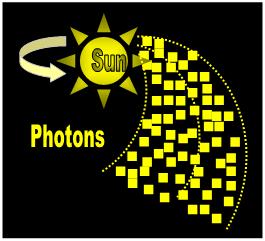
In Fig. 3, I illustrate Einstein’s ‘curved light’ obsession and refer to it as the ‘water sprinkler’ theory of light.
Think of what would happen to a photon emitted by one of the Sun’s atoms. The atom emits the lead
particle straight-ahead. Since the Sun spins, the same atom sends a second photon right behind but a
little to the side. A third photon rushes out a little further to the side, and so on. In other words, the entire
beam of photons originating from a given atom describes a curved path in space irrespective of the
presence of mass in the vicinity. This has to do with the spinning of the atom, the spinning of the Sun,
and its orbit around the galaxy. An atom in the Sun has no way of sending a series of discrete particles
‘straight’ to Earth.
Fig. 3 Al’s water sprinkler mechanism of light |
3.0 Problems with Einstein's Water Sprinkler Theory of Light
If light behaves anything like a water sprinkler, then the predictions of Einstein’s flashlight-in-the-boxcar
will not materialize. Allow me to exaggerate the distance from the passenger to the mirror to make my point.
Let’s assume that this distance is 5 light-seconds – the distance light travels in 5 seconds. (This implies
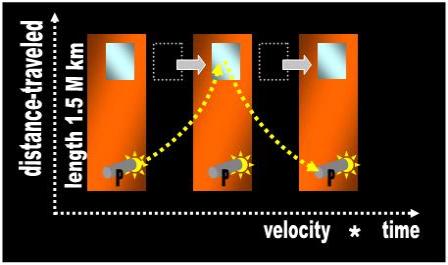
that the boxcar is over 1,500,000 kilometers in length). If each photon emitted by the flashlight is affected
by the motion of the flashlight, we will have a situation similar to the water sprinkler. The flashlight emits
the first photon and the boxcar moves. Then the flashlight emits a second photon and the boxcar moves
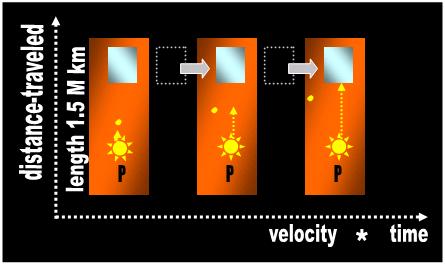
again. The series of photons should describe an arc rather than travel rectilinearly. The first photon should
hit the side wall as the car travels to the right and never make it to the mirror (Fig. 4). Surely the passenger
would notice that the beam never reached the mirror because he would not get a reflection. Therefore, the
prediction of relativity did not materialize. We have the little d’s and c’s (quantitative stuff) in place, but no
reflection (qualitative stuff). So what should the passenger or the observer conclude now?
If Einstein’s water sprinkler theory of light has its way and the passenger wants to hit the mirror, he would
have to point the flashlight obliquely to the region where the mirror will be in 5 seconds (Fig. 5). But then,
Einstein’s ‘curvilinear’ light violates almost every basic experiment ever performed with light, beginning
with the Principle of Ray Reversibility (PRR). The opticians routinely show in every one of their experiments
that light travels rectilinearly. Therefore, relativists should settle their differences with the opticians before
publishing further nonsense. Experimentation refutes relativity’s curved path theory of light.
Fig. 4 |
| Fig. 5 The water sprinkler theory of light applied to Al’s boxcar experiment. |
| If light travels curvilinearly as Einstein suggested (the water sprinkler theory of light), you would have to point your flashlight to the region where the mirror will be in 5 seconds if you want to receive a reflection. This proposal violates prac-tically all experiments of Optics. |
In addition, if light travels in curves, we cannot talk about velocity. Velocity is a vector quantity: its direction
is parallel to a straight line. Hence, Einstein’s water sprinkler mechanism is at odds with the definition of
velocity and with what opticians routinely observe in the field. As far as we know, light always travels
rectilinearly and we should talk about the velocity rather than the speed of light. It is Einstein’s warped
canvas theory that requires a curvilinearly-traveling particle.
The idiot of Mathematics has been brainwashed to answer like a zombie: Young’s slit experiment proves that
light travels in curves (i.e., diffracts). What he cannot explain is why at the same distances, the opticians can
show that light travels absolutely ‘straight’. We have to resolve once and for all whether light travels rectilinearly
or curvilinearly. Another famous reply is the geodesic. Relativists have made the geodesic unfalsifiably straight,
curved, rectilinear, and curvilinear. What is there to argue with such a formidable hypothesis?
But now let’s add a higher degree of complexity. What do you think would be the result in Einstein’s flashlight
experiment if we assume that light is a continuous wave, an inexhaustible river flowing out of the flashlight?
What if a wave – once emitted – remains permanently straight? Think of the flashlight as one of those
StarWars-type light swords: the light always remains parallel with the flashlight, straight as an arrow! No matter
what! (Again, focus your attention on what a wave is rather than on how it moves.) In order for light to touch
the mirror, the passenger merely has to point it directly at the mirror. However, the passenger must first wait 5
seconds for the wave front to reach the mirror. Then, as long as he is not foolish enough to turn the flashlight
off or interrupt its extension with nearby objects, the passenger can brighten far away objects instantaneously
by simply tilting the flashlight. The straight wave hypothesis violates the well-established concept of velocity
of light. If light can touch distant objects instantaneously, light does not travel at c.
So even if Einstein’s boxcar experiments don’t tell us much about time dilation, they are good exercises to
elucidate the true nature of light. Before we can accept Einstein’s explanation for the mirror experiment, we
must first determine the architecture of light. Without this, Einstein has nothing, and Mathematics certainly
won’t help him. How can light travel rectilinearly at the same time that it curves? This is the question that has
stumped relativists for a hundred years. I reply here.
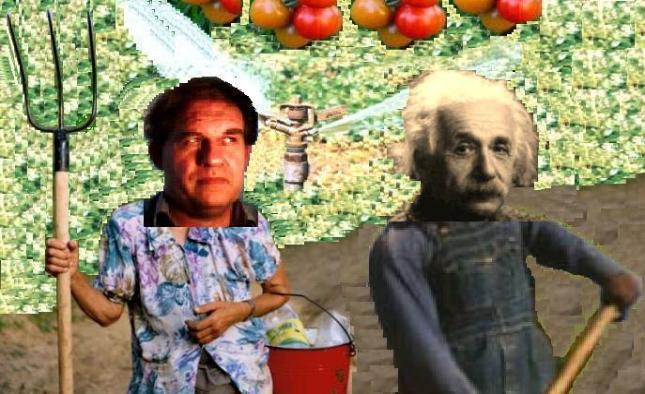

| If you wanna shower all them tomaters with photons, the sprinkler's gonna have to spin. |
| The passenger (P) points his flashlight at the mirror and light travels this distance roundtrip. The passenger measures the distance (d) as if the beam described a rectilinear itinerary. In the Monastery of Relativity, the monks equate static distance (a photograph) with dynamic distance traveled (a movie). In the foregoing equation, TimeP is the time measured (with a clock) by a passenger traveling on the train. Since the passenger does not perceive motion, his measurement is no different than if you took the measurement in your house (motionless scenario). |
| The boxcar is moving towards the right as the photon leaves the flashlight. According to the passenger (P), the ray of light bounced off the mirror and returned in a straight line. However, the distant observer (O) should see that light described an arc in space. Think of this as throwing a ball straight up in the air while traveling in a car. If you catch the ball again it is because the ball also moved in the direction of the car. |
| Every atom that comprises the Sun emits a series of photons. However, a spinning Sun should send the series of photons coming out of one atom like a rotating sprinkler system shoots out drops of water. The entire stream of photons should describe a curve in space. If relativists hypothesize that light consists of particles, they will unavoidably end up with the water sprinkler mechanism of light. |
| While inside a boxcar, you point your flashlight at a mirror located 1.5 million km away. Meanwhile, the boxcar moves to the right of the page with you in it. Will the first photon hit the mirror or the side of the boxcar (left side)? Will a stream of photons travel rectilinearly or curvilinearly? |


- Main module: How can relativists stretch time?
Pages in this module:
- 2. Pastor Al says that both of you didn't shake hands at the same time
3. This page: Pastor Al’s ‘water sprinkler’ theory of light
4. Pastor Al's atomic clock is out of order
5. Pastor Al says that his twin brother is half his age

- ________________________________________________________________________________________
- Copyright © by Nila Gaede 2008