| Adapted for the Internet from: Why God Doesn't Exist |
Relativists propose three different and irreconcilable ‘physical interpretations’ for gravity:
- a. The field:
- “ The gravitational field at any point in space is by definition the ratio of the gravitational force
acting on any object located at this point in space, to the mass of this object.” [1]
- b. The well:
- “ In physics, and specifically with respect to the Theory of General Relativity, a gravity well
is a distortion in space-time caused by a massive body such as a planet or star, or any other
object which has mass.” [2]
“ Space-time of General Relativity is supple and can be visualized as a rubber sheet, bent by
massive bodies. The Sun for example, being heavy, bends spacetime enormously. Planets
like Earth move in this curved geometry.” [3]
- c. The wave:
- “ Gravitational waves emanate from the sun and change the shape of space around it.” [4]
Therefore, unless you want to spend the rest of your life knocking down strawmen, you have to demand that
relativists clarify which of these is their true-blue version of gravity and hold them to it (Fig. 1).
The mathematicians may argue that I am misrepresenting and making a mockery of their beloved theory.
These versions are one and the same and it is I who just doesn’t seem to understand what relativity is about.
In their view, GR ‘predicts’ waves, fields, and wells without detriment to the others. That’s why we have the
$600 million Gravity Probe B project investigating the well and field versions and the $400 million LIGO
project investigating the wave. The way relativists see it, the field that surrounds the Sun is the famous well,
and waves are the undulations traveling through this medium. So what is it that I don’t understand?
Perhaps the real problem is that the mathematicians have not defined their terms rigorously enough and this
enables them to escape through loopholes during the feedback segment of their presentation. Is there no
difference between the object ‘well’ and the concept ‘field’? Are these words synonyms? And how do we
reconcile dynamic waves with a static well that is already there, stretched from Sun to Earth?
The problem is that the mathematicians incorporate these three irreconcilable mechanisms into a single
hypothesis in order to cover all the bases. This enables a mathematician to respond to criticism of one point
by invoking attributes of another. If you argue that the concept field has no physical way of attracting a
particle, the mathematician points to the well and describes how a marble spirals into a funnel [5] [6] or rolls
down a hill. [7] If you say that the well is a static object, the mathematician tells you that gravity is comprised
of dynamic waves. (pp. 29-30) [8] And if you say that a wave must necessarily travel from the Sun to the
Earth, the mathematician explains that a field exists permanently around our star. [9] Thus, they appear to
be consistent when in reality they end up chasing their tails around. What the mathematicians are doing, in
effect, is amending their assumptions retroactively.
So let’s distinguish clearly between these versions, show that they are irreconcilable, and compel the
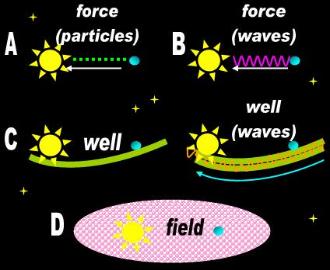
mathematicians to choose. The field version proposes that there is a magical substance (i.e., a ‘field’) that
envelopes a celestial object all around (Fig. 1 D). In contrast, a well covers only the bottom half of a celestial
object (Fig. 1 C). The Sun weighs the canvas down in one direction to produce a well (e.g., ‘downwards’). A
gravitational ‘field’ also differs from a ‘rubber sheet’ in that it cannot be illustrated all by itself in the absence
of the source and the target objects. A field is an abstract mathematical concept whereas a well (as used in
relativity) is presented as a physical object. It is irrational to propose that a concept such as a field has the
ability to affect particles or planets. Anyone using the word field to explain gravity is not offering a physical
interpretation. We cannot make a movie of a field because a field neither stands alone nor has shape.
The wave is not a valid hypothesis in and of itself especially if it is proposed as the undulation of nothing, but
here relativists are insinuating that these waves consist of ripples in space-time. They are proposing that the
physical object that is waving is the gravity well itself. If we assume that space-time is a physical object, like
we do in the well scenario, then the wave explanation can still be regarded to be in the running.
A non-starter with waves, however, is that they are undetectable. Caltech and MIT run the gargantuan project
known as LIGO. It consists of two intersecting and interfering lasers which would presumably distort if
perchance a gravity wave should pass by and tickle the detector. One wonders how the mathematicians plan
to catch these waves when Quantum Mechanics has as one of its principles that photons, gravitons, and
other ‘entities’ travel as waves and are detected as particles. As soon as the people at the LIGO control

center attempt to touch a gravity wave it instantly morphs into a particle. So assuming that the
mathematicians are successful, what will this expensive experiment prove? Will it prove that a gravity ‘wave’
is made of particles called gravitons and confirm the mechanics’ version of gravity over relativity? Do gravity
waves travel directly (i.e., rectilinearly) from the center of the Moon to the center of the Earth as Newton
insinuated (force) or do they travel along the curved gradient of the Earth’s well (i.e. to the South Pole) (Fig. 1
A vs. 1 C)?
A well is clearly amenable to illustration and this is the reason GR was heralded as a ‘physical interpretation’,
something that was missing until then. In contrast, Newton made absolutely clear that he had no hypothesis
to back his ‘force’ theory, and this certainly did not help his theory when it competed against relativity for the
hearts and minds of the mathematicians. But this, again, reinforces that the novel physical interpretation is
what attracted the experts of the guild to relativity and not a petty difference in numerical results as often
stated.
However, a well is as different from a wave as it is from a field. A well is static whereas a wave is dynamic. A
well is a photograph. A wave is a movie. A well is already formed and does not have to travel from here to
there. By its mere presence in space, the Sun weighs down the canvas, creates a dimple, and the Earth is
compelled to roll around like a tiny marble spiralling down a funnel. The Earth could roll around this roulette
without the well changing its shape. In such case, if gravity is simply the curvature of space, the effect of the
Sun’s presence on our planet is instantaneous. Indeed, GR’s equations predict so much in what the
mathematicians call the low velocity/weak field scenario:
- “ at low speeds and weak gravitational fields, general and special relativity reduce to
Newtonian physics, i.e. everyday experience.” [10]
“ The weak stationary field limit of general relativity reproduces Newtonian gravity with
instantanous action at a distance” [11]
What meaning would a gravity wave traveling at c have in the context of instantaneous action?
If, on the other hand, the motion of the Earth depends on waves coming from the Sun and these waves
travel at a ‘finite’ speed, the wave model can never be instantaneous as required by the well. A wave is said
to travel the 150 million km from the Sun to the Earth in 8 minutes. If these ripples are traveling along the
curved walls of the well, the distance has to be greater than if the same wave travels directly along an axis
connecting the centers of the Sun and Earth. Hence, relativists have to decide whether their gravitational
waves travel rectilinearly from the center of the Sun to the center of the Earth (force) or curvilinearly along
the wall of the Sun's well (i.e., the ‘field’ potential version). Nevertheless, these arguments show that the
wave and the well are two irreconcilable models for gravity. By blending them, relativists have borrowed
the best from the static and the dynamic worlds in order to protect their beloved theory from every possible
angle.
Fig. 1 The three irreconcilable relativistic physical interpretations of gravity |
- Module main page: General Relativity proposes three irreconcilable mechanisms of gravity
Pages in this module:
- 1. What is a physical interpretation?
2. This page: Relativists discovered the true mechanism of gravity: the field, the wave, AND the well
3. Is the speed of gravity finite or infinite?
4. What do the idiots of Mathematics mean by 'infinite speed'?
5. Fatal problems with Einstein's well
6. Einstein's ridiculous universe
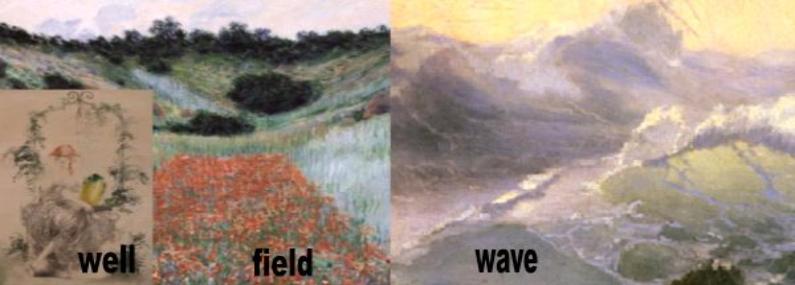



| Relativists discovered the true mechanism of gravity: the well, the field, and the wave. |
A. Newton’s force law (straight vector): The equation
requires instantaneous action. The problem with this
model is that instantaneity cannot be simulated with
one-way waves or QM particles (i.e., gravitons). By
definition we cannot depict motion in a still image.
B. GR gravitational waves: must necessarily travel at
slower-than-instantaneous speeds as required by the
definition of motion. However, if gravity traveled at the
speed of light, this would cause distortions in the
orbits of the planets. Be aware, however, that there are
two versions of the wave. One wave travels ‘straight’
from the Sun to the Earth (B). This is the ‘force’ version
of wave. The other wave is a ripple that propagates
along the wall of the well (C). This is the ‘potential’ or
‘field’ version of wave. This distinction will become
relevant when we discuss the speed of gravity.
requires instantaneous action. The problem with this
model is that instantaneity cannot be simulated with
one-way waves or QM particles (i.e., gravitons). By
definition we cannot depict motion in a still image.
B. GR gravitational waves: must necessarily travel at
slower-than-instantaneous speeds as required by the
definition of motion. However, if gravity traveled at the
speed of light, this would cause distortions in the
orbits of the planets. Be aware, however, that there are
two versions of the wave. One wave travels ‘straight’
from the Sun to the Earth (B). This is the ‘force’ version
of wave. The other wave is a ripple that propagates
along the wall of the well (C). This is the ‘potential’ or
‘field’ version of wave. This distinction will become
relevant when we discuss the speed of gravity.
C. GR gravity well (curved space): A gradient such as the Sun’s gravity well is alleged to be is
conceptually and by definition a static depression. It is permanently stretched across two objects.
In contrast, a wave has to travel from here to there. Therefore, the well model is a static version
whereas the wave model is dynamic. The well is also irreconcilable with the field version. A celestial
object may only push the canvas in a single direction. Relativists would like you to believe that in
4-D the Sun pushes radially. This is absolutely ridiculous. Just ask them to show you a motion
picture of their proposal to see if the orbits of Mercury or Earth would make sense then. The only
way the well analogy works is in 3-D.
D. GR amorphous field: Unlike a well, a field envelopes a celestial object all around. Unlike the wave,
a field doesn’t travel away from the object. A field permanently surrounds it. However, the word
‘field’ does not represent a physical entity. There is no such thing’ as a ‘field’ in Physics. A field is a
concept and thus cannot be comprised of particles. A field is formally defined as a ‘region of space’.
A region is defined as a ‘portion of space’ and space is defined as a ‘field’. This set of definitions is
circular.
conceptually and by definition a static depression. It is permanently stretched across two objects.
In contrast, a wave has to travel from here to there. Therefore, the well model is a static version
whereas the wave model is dynamic. The well is also irreconcilable with the field version. A celestial
object may only push the canvas in a single direction. Relativists would like you to believe that in
4-D the Sun pushes radially. This is absolutely ridiculous. Just ask them to show you a motion
picture of their proposal to see if the orbits of Mercury or Earth would make sense then. The only
way the well analogy works is in 3-D.
D. GR amorphous field: Unlike a well, a field envelopes a celestial object all around. Unlike the wave,
a field doesn’t travel away from the object. A field permanently surrounds it. However, the word
‘field’ does not represent a physical entity. There is no such thing’ as a ‘field’ in Physics. A field is a
concept and thus cannot be comprised of particles. A field is formally defined as a ‘region of space’.
A region is defined as a ‘portion of space’ and space is defined as a ‘field’. This set of definitions is
circular.
In conclusion, the mathematicians have to choose. They can’t have it every which way but lose. If LIGO
(waves) is right, Gravity Probe B (well) is wrong. The only reason relativists talk interchangeably about fields,
wells, and waves is to incorporate favorable static and dynamic aspects of each of these dissimilar concepts
into their theory.
How did the mathematical physicists end up in such a conceptual mess? Was it some bad moonshine they
drank?
We discover that the most critical factor underlying the question of gravity is the speed at which it acts.

- ________________________________________________________________________________________
- Copyright © by Nila Gaede 2008