| Adapted for the Internet from: Why God Doesn't Exist |
| In Science, it is irrational to attempt to measure distance |
1.0 A mathematician is an idiot who believes that space has dimensions
A mathematician stretches his tape from A to B and tells you that he just measured the distance between two objects.
- " The distance between two points in space can be ascertained with a rod, or a tape,
or by optical means, and the result depends essentially on the physical behavior of
the instruments used." [1]
" mathematicians have devised numerous definitions of dimension for different types
of spaces. All, however, are ultimately based on the concept of the dimension of
Euclidean n-space E ⁿ. The point E ° is 0-dimensional. The line E ¹ is 1-dimensional.
The plane E ² is 2-dimensional.models" [2]
" From the above geometric and physical arguments, we can conclude (not surprisingly)
that space is three-dimensional" [3]
- A physicist knows better. The mathematician is simply telling us the length of his tape. Where in the world did the idiots of
Mathematics ever get the idea that space has dimensions anyways?
- [Space has dimensions???? Bartender, I'll have whatever he had!]
- In Science, only physical objects may have dimensions.
The mathematician insists, this time with a clock. He sets it a-ticking while the cheetah runs and purports to measure
space or distance or distance-traveled or whatever they call it in Math. He finishes timing the animal and gives you a
value specified in meters per seconds or feet per minute. With a simple calculation, he converts this expression into a
'distance.'
You tell him that he has merely counted how many tiles he put in series on the floor. What he has done in effect with his
calculation is add up the lengths of the tiles.
The mathematician may try in other ways, but he will eventually learn what he never learned at the university. It is
conceptually impossible to measure emptiness: space, distance, void, nothing. We can only measure physical objects.
It is not space that has dimensions. It is the box or the floor or the tile or the tape that has dimensions (Fig. 1). From the
idiots of Ancient Greece to the morons of today, the mathematicians of the world have never learned this fundamental
lesson of measurement. Instead, they keep blabbing unscientifically about the dimensions of space, one-space,
two-space, three-space, 11 and 26-space. It seems like the number of dimensions of space increases proportionally
with the number of beers the bozos drink at the Math Club.
As a last resort, the mathematicians may defend themselves saying that this is just a semantic issue.
It is not. First of all, it is unscientific to say that space has dimensions, meaning that the volume a cube occupies is 3-D.
Volumes are not 3-D. Cubes and spheres are 3-D. A cube is an object. A volume is a dynamic concept. Concepts do not
have dimensions, especially if they are dynamic. Length, width,and height are static concepts. Concepts are relations
between objects.
Nevertheless, the idiots of Mathematics believe today that space is made of particles. Therefore, I am not overdoing it.
The mathematicians really perceive nothingness to have dimensions simply because they do not believe in absolute
nothingness. If the mathematicians believe that the statement 'space has dimensions' is just a metaphor, they should
not use it to communicate scientific ideas. They should leave poetry at the Literature class.
Fig. 1 The dimensions of space? |
| The mathematicians have lost their minds. They developed the most incongruous language in order to accommodate their ludicrous theories. One of their most stunning claims is that space has dimensions. |
| In Science, only objects have dimensions. The dimension we call 'length' is not the longest dimension as some mathematicians believe because dimensions have nothing to do with size. They are strictly qualitative concepts. The dimensions are named in reference to an observer. The width of an object runs horizontally, height runs vertically, and length runs perpendicular to both of them. (Perpendicular is not a quantitative concept of Math measured in degrees. It is a qualitative concept of Physics. The word derives from perpendiculum, the plumb bob used by ancient masons to gauge how crooked a wall was with respect to the horizon.) |
Fig. 2 Length |
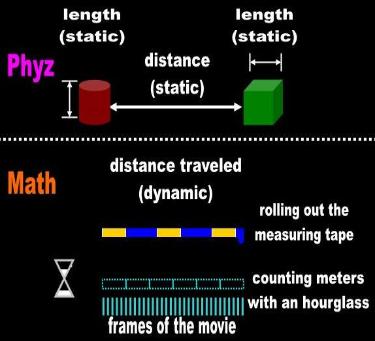
| The mathematicians get confused with the word length because they use two irreconcilable definitions of this word within the same dissertation. They measure the extension of an object and refer to this quantitative result as 'the length of the object.' They also insinuate that this meaning is equivalent to the dimension known as length (as in length, width, and height). It is not. Measured length is a movie of the front end of an |
Actually, the mathematician is not even giving you the length the tape. He anchors one end of the tape and unrolls the
rest so many yards or meters. From a conceptual point of view, he is again measuring the distance-traveled by the leading
edge of the tape from its starting point (Fig. 2). The fact that he can take the reading with a clock (i.e., piecemeal) or express
the results in terms of time (i.e., meters per second), indicates that measurement is a dynamic activity.
In different words, the mathematician is measuring the rate at which the tile-layer lays tiles down. Think of the old nautical
knot. The mathematician makes a standard, e.g., the meter. Then he checks his speed, e.g., 5 meters per second. Hence, if
he travels 5 seconds, from a conceptual point of view, he has laid 25 tiles in a row or counted 25 knots or whatever. The
ticks on a clock simply count how many rulers the mathematician has placed between his starting and ending location.
The distance of Mathematics is actually the distance-traveled by a single object. The word motion is defined for a single
object. When we talk about motion we are comparing the apple’s current location against its now imaginary origin. When
an observer talks about motion and verifies distance-traveled he is relying on his memory. In the instant scenario, the
mathematician is comparing a real entity (the leading edge of the tape) with an abstract location (the starting point of the
leading edge of the tape).
2.0 In Science, you can't measure length or distance
These objections raise an even more fundamental question. Is it possible to measure genuine length or distance at all?
Imagine speeding down a straight track on a train. How far are you from the end of the tunnel? How would you measure
this distance if you can only conceive of and measure the distance between two objects horizontally or laterally
(i.e., perpendicular to your line of sight)?
The only way that a mathematician can measure distance separating him from the end of the tunnel up ahead is again
dynamically, for example, by ricocheting signals off the far wall. Otherwise, he can measure this static distance in retrospect
with a clock or by unrolling a measuring tape, which means that he had to define the standard first. The only way to define
the 'length' standard is horizontally. In either scenario, the mathematician measures distance-traveled by one object
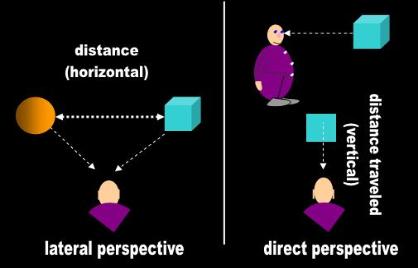
(vertically). He is not measuring the static distance between two objects (Figs. 3, 4 and 5). Distance-traveled is a movie.
Distance is a photograph. Thus, the paradox is that a mathematician can only measure static, horizontal distance through
dynamic, vertical methods (unrolling a tape, laying tiles down, counting seconds, etc.). Again, Math and Physics don’t mix.

| Look Bill! Let's see if I can make you understand. In our beloved mathematical Hell, it is not the chair which has dimensions. It is the space the chair occupies which has dimensions. This is how we measured that your stretched arm is a one-dimensional space. Any more questions? |
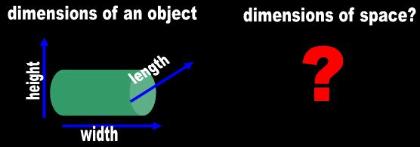
Fig. 3 Horizontal vs. vertical distance |
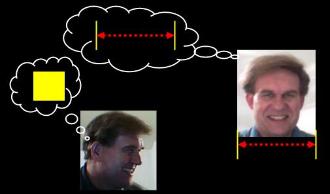
| The distance of Physics is not measurable. It consists of a qualitative gap between two objects (horizontal distance). The ‘vertical’ distance of Mathematics, in contrast, (i.e., the distance traveled by one object) can only be measured dynamically. When we measure the length of an object or the distance between two objects, we are in effect using a dynamic, vertical method to measure a horizontal, qualitative parameter. We are using a clock, laying tiles, etc. |
| In Physics, we use the word 'distance' to refer to the static gap that separates two objects. We informally use the word 'length' to refer to the extension of an object along any of the dimensions. Formally, length is simply one of the three dimensions. |

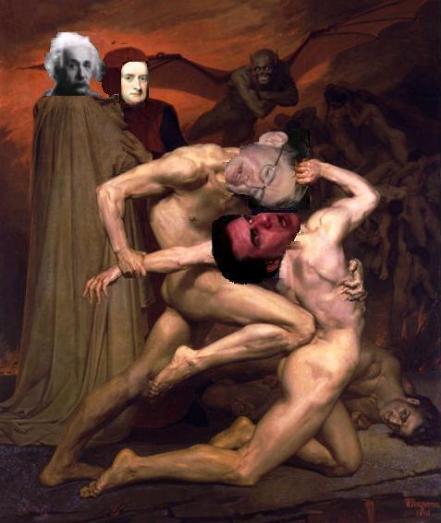
| Hey Newt? What's Steve doing? |
| Fig. 4 Distance from the bserver's perspective |

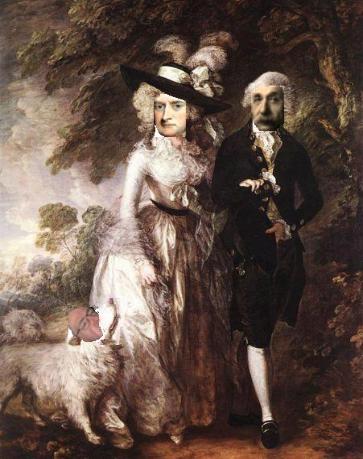
| Yeah! Let's walk! If I don't travel a distance soon, I will poop on the length of your shoes! |


| In order to know the length of our relation, we must walk the distance, my dear. |
Module main page: A mathematician doesn't understand the difference between length and distance
Pages in this module:
- 1. Length and distance are not synonyms for the purposes of Science
2. In Physics, we don't measure distance
3. In Mathematics, there is no such concept as distance
4. This page: In Science, it is irrational to attempt to measure distance
5. Is the radius of a circle a distance or a length?

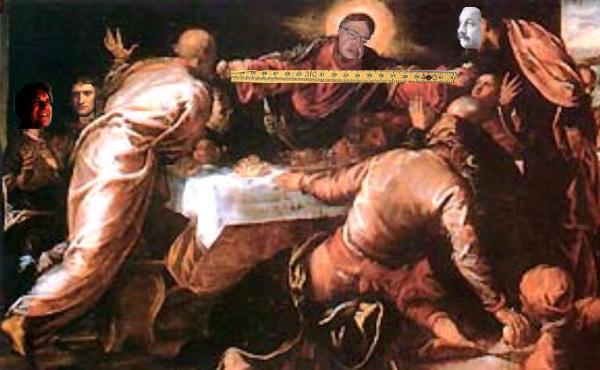
| He's measuring the dimensions of space. |
I'll run all that by again in different words. In Science, we can measure neither length nor distance. The length of Physics is
the continuous matter lying between two surfaces. There is only one way to visualize this: horizontally. You must stretch
the object in front of you from arm to arm and measure its length with a caliper or ruler. You can measure the length of an
object only if it faces you sideways. The same occurs with distance. You must be staring at the two objects side by side
and not in series, for then you would not be able to take a measurement. On the other hand, the distance-traveled of
Mathematical Physics is always measured in series (vertically) (Fig. 3). It can only be measured after a horizontal standard
has been established.
Actually, it is much worse. From a conceptual point of view, what the mathematician has done is freeze the entire Universe
and ensures that everything stands absolutely still (except for himself and the tape he holds in his hand). He hammers a
stake in the middle of space and fixes a mathematical 'position' (what in Science is known as a location). He refers to this
surrealistic vision as a 'frame of reference' and tells you that it has something to do with Physics and with the real world.
Now that things are properly anchored, he unfurls his tape from A to B, takes a measurement, and then allows the Universe
to resume its regular movement. A good analogy of this mathematical idiocy is the Twilight Zone's episode titled 'A kind of
a stopwatch' You should watch it just to discover what the mathematicians of the world are into.
The distance-traveled of Mathematics is a collage of sequential frames of a film pasted onto a photograph.The
mathematician insinuates that he is talking about horizontal length and distance – which is what most people understand
by the words length and distance – when he is really alluding to vertical length and distance (Fig. 4). The distant observer
visualizes distance between two objects (Fig. 4) The traveler measures distance-traveled in his direction of motion (Fig. 5).
The lengths and distances of Physics are static concepts (photographs). The ‘lengths’ and ‘distances’ of Mathematics
involve time.
3.0 Conclusions
To recap, in Mathematics, there are no such concepts as length or distance. In Mathematics there is only distance traveled, a
dynamic, quantitative relation. The mathematician makes a standard and specifies the length or distance of Physics in terms
of so many units of this standard. The mathematician has devised several ways of measuring length:
- • rolling out the tip of a measuring tape
• placing tiles in series and counting the number of tiles
• widening the opening of a caliper
• counting ticks with a clock
• ricochetting a signal and measuring speed or time with a clock.
- Mathematics has no use for the qualitative, static lengths and distances of Physics. The infamous 'distance' of Mathematics
is in all cases distance-traveled, a dynamic, quantitative concept. The distance-traveled of Mathematics is an itinerary
measured in meters or miles. It consists of a movie of the leading edge of a tape moving from here to there or of a ticking
clock or some other dynamic method. The distance of Physics, in contrast, is between TWO objects. The alleged 'distance'
of Mathematics consists of the trajectory of ONE object. The mathematicians are like stone masons, placing tiles on the floor
to know the extent of the wall. Whether referring to length or distance, the mathematician measures dynamically and presents
the results in terms of predefined units. A mathematician does not point to a photograph. He asks you to watch a movie. The
mathematicians have no use for a 'qualitative' caliper. The tool they use to measure 'length' and 'distance' is a clock. However,
unbeknown to them, they are not even measuring distance-traveled. They are measuring the length of the object they use as
a standard. If a mathematician counts 5 tick marks on his clock, he has measured 5 of his standards as if they were one and
still knows nothing about the 'length' of 'space.' The differences between the distance-traveled of Math and the distance of
Physics is another example of how different these two disciplines are.
As a result that the mathematician alludes to length, distance, and displacement with the word distance, he cannot use his
definition of distance consistently (i.e., scientifically), for instance, to provide a physical interpretation to a phenomenon of
nature. In extreme cases, this leads to ridiculous conclusions as exemplified by the 'space-like'/'time-like' idiot-talk of relativity.
| Fig. 5 Distance- traveled from the traveler's perspective |
| unrolled tape or the number of tiles the mason put in one hour. This 'length' is qualitatively different than the 'static' length forming the triad of a 3-D object. |

- ________________________________________________________________________________________
- Copyright © by Nila Gaede 2008