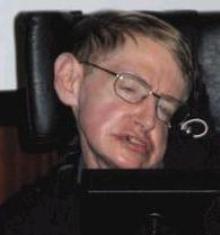
Stephen Hawking
(1942 - )
(1942 - )
Hawking is the most important contemporary celebrity of Mathematical Physics, a shining icon of Einstein's legacy:
- " there is no other scientist alive as famous as Stephen Hawking" [1]
The mathematicians coming out of college can only dream of attaining so much as half his popularity.
Ironically, Hawking is more famous for his disabilities than for his abilities. Most people probably don't have the slightest
clue what he contributed to Physics, but everyone who's heard about him knows that he lives his life in a wheelchair. A
fellow once said to me, "Man. This guy Hawking is handicapped, but look at how smart he is." Of course, this fellow didn't
know anything about Hawking other than his disability, and only because he saw Hawking on TV. Certainly, Hawking
hasn't won a Nobel Prize. So what is he famous for?
If Einstein's curved space and Bohr's Quantum weren't enough fantasy, Hawking et al., had to develop the ridiculous
black hole to unprecedented heights. A black hole is a startling non-entity, an abstract concept that has the ability to
swallow particles, clocks, and astronauts. You should take extra care if you are ever near one because you never know
what it is going to do to you. It might peel off your skin in a single swoop and spit it out as X-rays. Think of love and
beauty as having the power to eat your breakfast. That's about how much sense the notion of a black hole makes.
A black hole has essentially two components: a singularity and an event horizon. The singularity is a mathematical
abstraction that originates when the idiots of Mathematics with no common sense or street smartness take and attempt
to pass their ludicrous infinities for realities. The event horizon is, as its name indicates, a region. A region is another
abstraction, like a horizon is an abstraction. Think of heat emanating from a camp fire. If you are close enough to the
flames, the invisible heat can char your skin. This is more or less the idea behind the infamous event horizon. However,
in Physics, two abstractions do not a reality make. But Math is a different world. Anything can happen in relativity, and
the more fantastic the explanation, the more people will believe it.
All was not well in theoretical science in 1960; indeed, theoretical science was as sick as it could be. It is somewhere
around this time that Hawking, Penrose, Thorne, and others came along and put their combined intellectual weight
behind the black hole. It didn't take long for the morons manning the big telescopes of Earth to bow to authority and
begin seeing black holes at the bottom of their empty beer cans. Today, nobody questions the existence of black holes
just like nobody questions the existence of Big Bang, virtual particles, and dark matter, or the ability to travel backwards
in time.
Around 1980 Hawking published A Brief History of Time, which enormously popularized the mathematical fantasies and
irrationalities entertained by the global community of mathematical physicists. His biographers explain:
- " A Brief Hisotry of time has notched up worldwide sales in the millions -- publishing
statistics usually associated with the likes of Jeffrey Archer and Stephen King" [2]
- After that, it was all gravy. Hollywood now had the go-ahead to treat religion as science. Time travel, wormholes, creation
ex-nihilo, and teleportation were no longer the types of ideas over which religion had a monopoly. These fantastic
explanations and others were officially incorporated into mainstream 'Physics.'
Hawking spearheaded this movement and should take the credit as well as assume the main responsibility. He has done
more than anyone to popularize Mathematical Physics in general and relativity in particular. He is the celebrity all
mathematicians coming out of college wish to be, the darling of the establishment, a movie star to laymen, who
erroneously identify him with Science. Hawking was already touched by the royal sword and made a Commander of the
British Empire (CBE), making him now larger than life. [I have no idea why the Crown bestowed such honor on Hawking,
but I have become convinced that it is due to his direct or indirect contributions to scientific documentaries such as The
Twilight Zone, The Time Tunnel, and Star Trek.]. And as we all know, the CBE is something like a stepping stone to the
next level: getting a star on the Walk of Fame. Hawking has already acted and written for Hollywood. So I predict that in a
brief period of time we will see a star (or perhaps a black hole) bearing his name on the famous walkway.
| The poster boy of Hollywood Physics |
- ________________________________________________________________________________________
- Mathematics General Relativity Special Relativity Quantum Mechanics String Theory
- Last modified 01/22/08
- Copyright © by Nila Gaede 2008