| U.S. Ass. D. A. Lee Altschuler |



| U.S. District Attorney Michael Yamaguchi |
The prosecutors charged me with Mail Fraud and Interstate Transportation of Stolen
Goods. They claimed that I stole information belonging to Intel Corporation and
mailed it to Advanced Micro Devices. Now why would I do that?
According to what the FBI told the press, I was remorseful for having taken material
from AMD for so long and wanted to make amends with the company. They must've
worked overtime to come up with that one! There was no mention of my meeting
with the head of the CIA in Buenos Aires in their press releases and that he
'encouraged' me to cooperate with the agency... or else...
What the prosecutors feared the most was my Motion to Dismiss, especially after
I fired my 7th court-appointed attorney and decided to represent myself. A Motion
to Dismiss is a brief one files with the court to declare that there is no legal case
against the defendant. What would they tell Intel? That they arrested me, but had
no case against me?
My arguments were pretty straight forward:
So what did the prosecutors do? Did they fight the legality of the detention in court?
No! They did it the American way. They made me an offer I couldn't refuse. They
kindly asked to plead guilty or they would put my wife away. The carrot they
offered was to recommend to the INS against deportation. They did so despite
that Judge Whyte, the prosecutors and the INS knew that I was an illegal alien.
I entered the US in 1974 and then again in 1977 with a tourist visa and overstayed
20 years.
Goods. They claimed that I stole information belonging to Intel Corporation and
mailed it to Advanced Micro Devices. Now why would I do that?
According to what the FBI told the press, I was remorseful for having taken material
from AMD for so long and wanted to make amends with the company. They must've
worked overtime to come up with that one! There was no mention of my meeting
with the head of the CIA in Buenos Aires in their press releases and that he
'encouraged' me to cooperate with the agency... or else...
What the prosecutors feared the most was my Motion to Dismiss, especially after
I fired my 7th court-appointed attorney and decided to represent myself. A Motion
to Dismiss is a brief one files with the court to declare that there is no legal case
against the defendant. What would they tell Intel? That they arrested me, but had
no case against me?
My arguments were pretty straight forward:
- 1. I didn't steal. I copied. Copying is not a crime. The statute doesn't penalize
copying. Steal, you steal a tangible. When you steal a shoe the owner can't
wear it any longer. On the other hand, intangibles can only be copied. People
can listen to the same music and watch the same TV programs simultaneously.
Relief is obtained by way of civil as opposed to criminal law. Intel did not shut
down because I copied its specs.
2. I didn't copy anything belonging to Intel. Like all major corporations, Intel does
not patent its fabrication process. In order to have protection for intellectual
property, a company must disclose what it wants protected to the patent office.
As a result of my case, Congress enacted the Industrial Espionage Act of 1996.
3. There was no motive for this crime. The indictment did not even mention
that any money was requested or changed hands. Since Intel and AMD have
essentially the same process, what did the instant crime consist of? What
damage or harm was done and to whom and for what reason?
So what did the prosecutors do? Did they fight the legality of the detention in court?
No! They did it the American way. They made me an offer I couldn't refuse. They
kindly asked to plead guilty or they would put my wife away. The carrot they
offered was to recommend to the INS against deportation. They did so despite
that Judge Whyte, the prosecutors and the INS knew that I was an illegal alien.
I entered the US in 1974 and then again in 1977 with a tourist visa and overstayed
20 years.
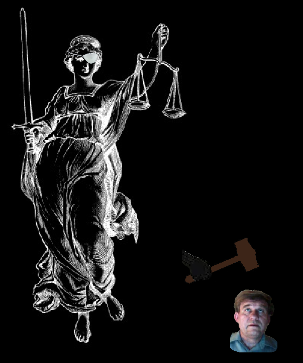
Yankee justice
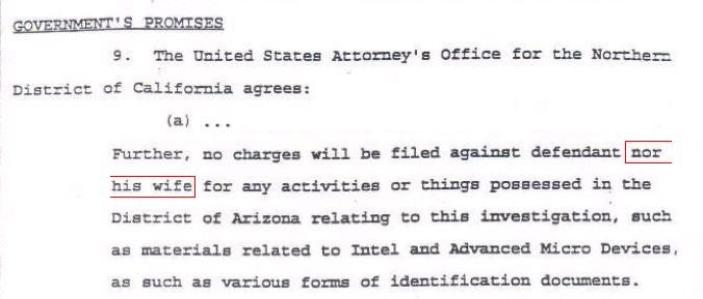
They went after my wife
(See Plea Agreement)
(See Plea Agreement)



| U.S. District Judge Ronald M. Whyte |

<<<The book
The movie>>>
The movie>>>

