| Mother Nature's economy is one-way |
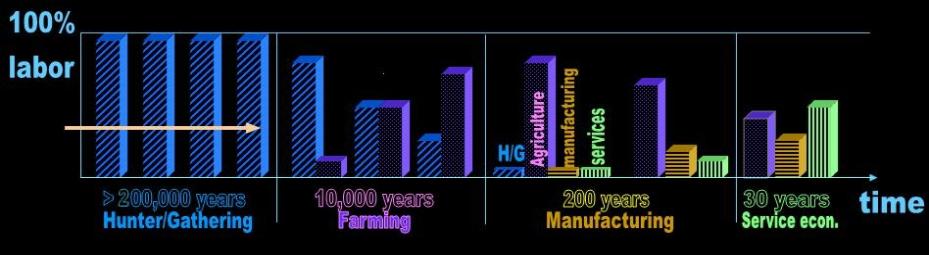
Man's linear economy through the ages
Humans started out like any other animal: as hunter gatherers, living off the fat of the land. We lived like
this for over 90% of our existence. Then, things evolved exponentially as we became more proactive in
our production of food. We invented/discovered agriculture and domestication a little over 10,000 years
ago.
Manufacturing replaced this inefficient system some 200 years ago and services replaced manufacturing
30 or so years ago. It is impossible to revert this trend for 7 billion people. We have no chance, for
example, of going back to our glorious days of hunter-gathering even if we wanted to. This reversal is
IMPOSSIBLE! Therefore, there are things which Man with all his intelligence and technology simply
cannot do.
this for over 90% of our existence. Then, things evolved exponentially as we became more proactive in
our production of food. We invented/discovered agriculture and domestication a little over 10,000 years
ago.
Manufacturing replaced this inefficient system some 200 years ago and services replaced manufacturing
30 or so years ago. It is impossible to revert this trend for 7 billion people. We have no chance, for
example, of going back to our glorious days of hunter-gathering even if we wanted to. This reversal is
IMPOSSIBLE! Therefore, there are things which Man with all his intelligence and technology simply
cannot do.

- Economists, their mothers, and everyone else have this mistaken idea that the economy of humans is an
open-ended system. We either grow eternally or level off somewhere and continue more or less parallel to
the asymptote per secula seculorum. There is no provision for irreversible decline. It would be too pessimistic,
and no one envisions such a turn of events anyways. If there is one thing practically everyone believes in is
that it is impossible for the human economy to go to zero. As far as the world is concerned, the long term
trend is an eternal bull market sprinkled with bearish blips here and there. Even the most pessimistic analyst
will talk about 'collapse' and immediately prescribe a solution or an alternative world where cooperation will
replace competition. The economy, so the worldly wisdom goes, has always bounced back. Booms and busts
are cyclical, normal ups and downs of the market. It's just the nature of the beast. It's has always been that
way. Temporary declines are the product of moods, herd mentality and... perhaps... manipulation of the
market by the filthy rich.
The error in this reasoning consists in assuming that God created Man and the Universe 100 years ago.
Economists suffer from extreme myopia when it comes to history. They analyze what has happened to
markets in the last 10 or 20 decades at most. There is no reason, in their opinion, to go beyond the days
of Luis XIV or to the days of Caesar to figure out what the future holds. Those economies were far different
than ours today. What can they teach us about contemporary or upcoming Economics?
But here we are going to go a step further, past the era of civilization. We're going to look at the entire
history of Man. In order to analyze population aspects such as genetic diversity, homosxuality, autism,
density dependent birth rates, and aging we need to look at the entire history of Man. In the same vein,
when we study Man's economy we need to look at what happened since the birth of our species some
time around 200,000 years ago. And here there is no doubt. When we look at our economic system and
our culture in this context, we conclude that our economy is not cyclical, but linear.
For over 90% of the time modern humans have been on the Earth, they were hunter-gatherers just like
any other species. Hunting and gathering were our primary economic activities for 190,000 years! Even
fundamentalist Christians who believe in the 7,000 year old world of biblical fame have to concede that
Esau worked as a hunter while his smarter brother Jacob, more in tune with the times became a shepherd.
Neither one was a blue collar manufacturer or a white collar service provider. Our economy, together with
our culture, evolved from these modest beginnings to the complex world we have today. We replaced the
hunter-gatherer with the more efficient farmer, the farmer with the more efficient manufacturer, and the
manufacturer with the more efficient service provider. We never went back. Our economic system simply
forbids it. Once we invent something and introduce innovation that makes life more comfortable, it is
impossible to unlearn it and make our lives more miserable. It is simply impossible for humans to revert
back to a stage where the main activity is manufacturing, where most workers work in manufacturing.
That era is gone, replaced by one in which machines and robots do the work. In fact, we are moving
irreversibly away from manufacturing towards ever more services.
Those who argue that humans have no need to go back to manufacturing miss the point. The point is that
we have just identified something humans, with all their intelligence, with all their foresight, with all their
technology cannot do no matter what. They cannot overcome efficiency. Efficiency coupled with self-interest
irreversibly pushes the human economy forward towards an ever more efficient system. This is the
unavoidable nature and consequence of our intelligence.
So let's synthesize our first conclusion:
- It is impossible for the human economic system to go back to manufacturing.
No matter what the economists of the world concoct, no matter what the governments of the world do, we
will never again go back to manufacturing even if we reached consensus that therein lies the solution to our
economic problems. Going back to the Era of Manufacturing is no longer an option.
Are you skeptical? You still have doubts? You still don't agree?
Let's tighten the screw one more notch and knock naysayers off the fence. Let's take our argument to a
more basic level.
- It is impossible for the human economic system to go back to agriculture.
If someone still harbors doubts and argues that we can invent some gadget and put billions of people to
work in manufacturing, he will be hard-pressed to propose that we can go back to the days of agriculture
where just about everyone worked in the fields. The extreme skeptic may want to conjure an idealistic
scenario where 7 billion individuals plow their personal plot of land by hand or with an ox, but such a
proposal would just raise eyebrows as to the mental state of the proponent.
And if that fails, we can always twist the skeptic's arm until he finally concedes or passes for an idiot:
- It is impossible for the human economic system to go back to hunter-gathering.
Anyone who truly believes that 7 billion humans can grab spears, bow and arrows, or even guns and
cannons and go out there to the... park?... zoo?... and bag a deer or a bear really needs to be locked up
for his own safety. What would we hunt? Domestic cats? An elephant at the zoo? What would be gather?
Traffic lights? Beach pebbles? What would we scavenge? Dead pigeons? Grasshoppers? Are there
wildebeest and alligators running rampant through the highways anywhere near your apartment? Can 7
billion people make a living scrounging for termites and ants?
I hope I have made my point. Irrespective of how intelligent and resourceful we are, there are things we
simply can no longer do. One of them is that we cannot take our artificial economy back to the former,
glorious days of manufacturing, agriculture or hunter/gathering. The Big Picture is that our grand economic
system is a one-way street. Our global economy is not cyclical, but linear. The Harvard economists confuse
Wall Street with Mother Nature's Way.
.
| To comment on any of the pages in this website go to: Rational Scientific Method |


| The History of Life on Earth |
