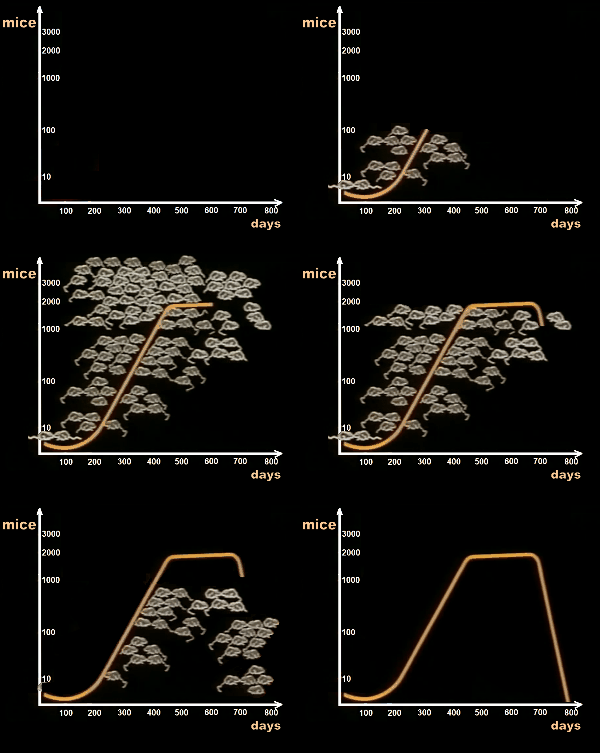
The mice in UU-25 multiplied exponentially during the first phase. In the second phase, they developed two problems that curiously affect our overcrowded species: autism and homosexuality. The last phase is characterized by a sudden drop in fertility and ends in the extinction of the colony. Calhoun interpreted the results as an analogy for the fate of humans. |
- Causes
Calhoun was a psychologist. Therefore he, his colleagues and his detractors considered a single factor in
their analysis of the results: overcrowding. He concluded that after a certain population density is attained,
the constant encounter with anonymous cousins seems to induce the mice to lose their individuality. They
can't cope with the rat race so to speak. The new generations also realize that all the social niches are
filled. The mice stop reproducing and having normal sex lives. Overcrowding and overpopulation are known
in biological circles as density dependent birth rates (DDBR).
There is, however, a genetic component to the phenomenon: the Founder Effect. All the mice in his
experiment descended from the original four couples. In fact, mice can start reproducing after they are
two months old. Pregnancy lasts only 20 days and they can reproduce all year around. Since mice live a
little over two years, the peak population of 2,200 individuals that the UU25 experiment attained very likely
included the original founders of the dynasty. There was incest galore! Inbreeding cannot be brushed aside
in this experiment.
Let's now add another genetic factor. When did Mother Nature create the mouse? Was it at the beginning
of the 20th Century?
The record seems to show that mice diverged from rats perhaps between 8 and 14 million years ago. This
means that mice have been around for a few million years. They had all this time to radiate and get used
to certain diseases that certainly were fatal to them millions of years ago. It is this extremely slow sifting
process known as genetic drift, passing through countless demographic bottlenecks, that results in the
standardized mice we use in our experiments today.
Let's add to this that laboratory mice are bred specifically for the purposes of investigation. What effects
this special treatment has on genetic variation we are only beginning to study and understand. The point is
that, for all we know, Calhoun may have started off with mice that were already brothers and sisters from
a genetic perspective. Assuming this is his starting material, it wouldn't take but a handful of generations to
produce deleterious genetic disorders such as autism and homosexuality. It is to note that researchers
seldom if ever factor in their reports whether drosophila or norvegicus (which they use often in their lab
experiments) are new species. How long have the fruit fly and the lab rat been around? How many
population bottlenecks have they experienced throughout their history?
We also have to look at what happens when density starts having an effect on social hierarchy. When the
mice are first placed into the enclosure, ideally they are all equal. Each male has a female and each couple
makes a nest. There's room for everybody. Food is plentiful. Life is good. It's Adam and Eve in the Garden.
At some point the population swells and there is a struggle for space. The dominant and subordinate mice
come into being. We have the rich and the poor, the masters and the slaves, the aggressive and the passive
and, perhaps... the sadists and the masochists. When humans were nomadic hunter-gatherers, there was
no competition for game or for land because space was an unlimited resource. Land starts becoming a
scarce resource when we enter the phase known as civilization, when we discover farming and
domesticating, when we nucleate in villages and maneuver for productive parcels. It is competition that
triggers the dominant and subordinate members of a species to appear. The more intense the competition,
the more the weaker members are alienated... and become known as Mgtows...
Therefore, it is tempting to conclude that autism and homosexuality develop in certain animals toward
the end of a species' life and that these behaviors become more accentuated towards the very end once
the population increases exponentially. A stunning statistic is that we find more genetic diversity among
chimpanzees living in a given region than within the entire human race! There is less than 0.1% difference
in the genetic information contained in the DNA molecule between any two humans. From a genetic
perspective, contemporary humans are in effect marrying brothers and sisters no differently, we may add,
than Calhoun's mice! This fact is more intriguing when we discover that the Neanderthals also ended up with
little genetic diversity toward the end of their reign.
Utopian Universe 25 |
- The Utopian Universe
For over 30 years, psychologist John Calhoun carried out several experiments with rats and with mice.
Calhoun was interested in studying the effects of spatial constraints on the behaviors of rodents. In his
classical test -- known as Utopian Universe 25 -- Calhoun placed four pairs of healthy mice in a 9 ft²
enclosure and watched them multiply. The animals had access to unlimited quantities of food, water, and
nesting material and were free of diseases and predators. The only limitation was space. After 300 days
the population had topped 600 mice and Calhoun observed that some individuals began to act in strange
ways. The population continued to grow until there were over 2200 mice, most of them exhibiting obvious
mental disorders, specifically of a homosexual nature. Shortly after, the entire colony died. All of Calhoun's
experiments with mice and with rats ended up pretty much in the same way.
| Of Mice and Men |
What was astonishing about Calhoun's experiments is not only that the mice went through an exponential
demographic growth phase that ended up in extinction. What was shocking is that after attaining certain
densities the mice developed autism, homosexuality, and asexuality. Calhoun was among the first
researchers to create these behaviors in the lab. Interestingly, these are the type of mental disorders that
afflict ever more humans these days.
As expected, psychiatrists and psychologists and affiliated individuals moved quickly to suppress his findings.
Specifically, they accused Calhoun of being too eager to equate humans with animals, the most common
accusation. So much were the shrinks offended by Calhoun's conclusions that practically all that survives of
his work is a children's story -- The Secret of NIMH -- that alludes to the organization that funded his research.
The cartoon makes a travesty of his research, a modern day Frankenstein tale where an experiment gets
out of hand. The establishment watered down the implications of Calhoun's experiments and decided not to
popularize them. As a result very few people, especially among those debating the issue of homosexuality,
have heard about Calhoun or his findings. We should be reading about his mouse experiments every day.
There should be a global debate on his findings because they have a bearing on the future of humanity.
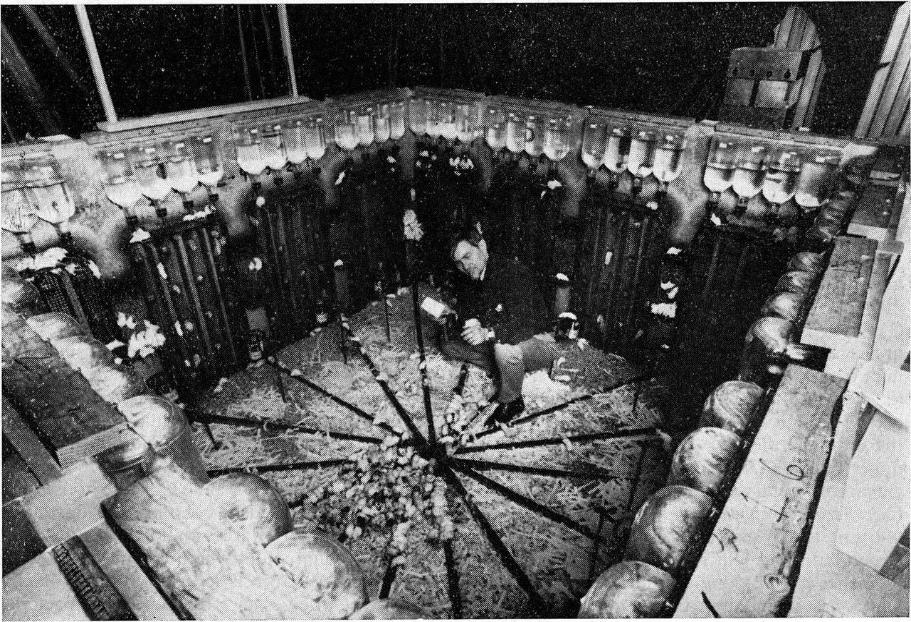
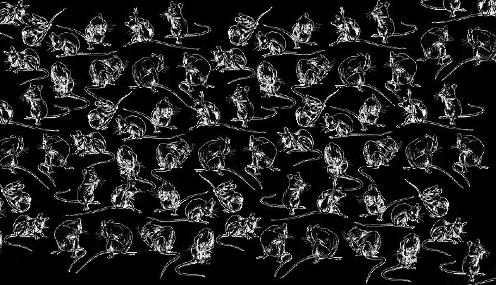
| John Calhoun in his Mouse Utopian Universe 25 |
"Was it this crowded when you founded the colony, great-grandpa?" |
The Beautiful Ones Homosexuality has no future! Homosexuality is just a sign that we are the last humans on Earth! |

We aren't rats
The main objection detractors lodge against Calhoun's results is that humans are not animals. Yes! Most
people in the world live with this amusing notion that humans do not belong to the Wild Kingdom. There are
rocks and minerals, plants and animals, and humans. These people therefore conclude that whatever
happened to the mice in no way reflects upon our species. We have intelligence. We have Technology. And
we have much greater tolerance for density, overpopulation, and crowdedness.
What all these bright people fail to explain is why humans are having the same symptoms as Calhoun's mice.
We have more homosexuals, asexuals, transsexuals, autists and people with other mental disorders coming
out of the wombs every day. They fail to answer in what way mice and men are different with respect to
density dependent birth rates and the washing of genes. They further fail to pinpoint in what way intelligence
and technology can overcome density and aging constraints. Why wouldn't the mice begin to reproduce again
once the population drops back to 8 or 15 couples? Why don't the last 20 or 30 mice jump-start the colony
again? The ball is in their court.
Calhoun's experiments in fact are more than a perfect analogy for what is happening to humanity. We are
the last hominids. There is no other hominid after us, nothing we can or will evolve into. We are not going to
become pygmies through an insular dwarfism process. And we are not going to change genetically in a
radical way as to produce some kind of new species. We are it: the last of a long dynasty that started with
tree dwellers in the early Cenozoic and before that with some kind of rodent like animal in the Jurassic or
thereabouts. The status quo is that after millions of years the entire family tree of mammals, including its thin
branch of hominids, has washed its genes. It is the same process that the Amish have undergone in the
last 400 years, but slower and with many more individuals involved. There is ever scarcer genetic diversity
among each of the species of mammals and very little left of it among humans. We are 7 billion individuals
stranded on a rock swirling through space. If the mice were Calhoun's test subjects, humans are the mice in
Mother Nature's experiment. We have nowhere to go and are now interbreeding to exhaustion. And of course,
under these circumstances, we are starting to see what Calhoun observed in his lab: the appearance of ever
more autists and homosexuals. We are starting to see the weirdest diseases imaginable, nothing like we've
ever seen in history. These congenital diseases are the result of inbreeding among members of a species
that has lost its genetic diversity. A couple of them help place the predicament that humans face in the right
perspective:
- 4. The boy who was a grandfather
5. The girl with two heads
6. Tree Man
7. Mermaid girl
8. Born with no arms
9. Six finger family
10. Demented sisters
11. Albino girl
12. The girl who never sleeps
- Anyone who dismisses these cases as 'outliers' and just 'interesting' has missed the lesson of genetic
cleansing. What you are witnessing is Mother Nature's final straw, her way of ensuring that our species
does not rule forever. She only allows a species to be king for a day.
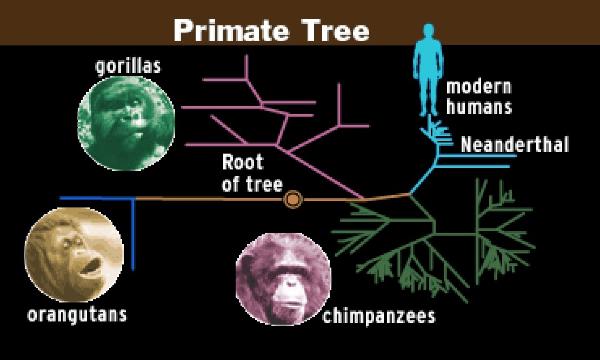
Several Studies have confirmed that chimpanzees have more genetic diversity than humans. One study concluded that a single group of 55 chimps from West Africa has twice the genetic diversity than the entire human race. The official view is that sometime in the distant past near the time humans branched off from chimps our population suffered a serious collapse, perhaps as a result of disease or catastrophic accident. But what if there is another mechanism at work? |

- 3. The Jews
4. The Egyptians
- 5. The Greeks
- 6. The Romans
- c.
- 7. The Chinese
- 8. The Vikings
- 9. The Aztecs
- 10. Two-Spirits
11. The Sambia Tribe
- 12. The animals
- 13. The day we created homosexuality in the lab
- II. Politics and Opinions
1. The Gay Agenda
- 2. How the shrinks 'normalized' homosexuality
3. My personal opinion about homosexuals
4. What does the term homophobic mean?
5. How the Gay Lobby neutralizes 'homophobes'
6. Should homosexuals be allowed to marry their kind?
7. The purpose of sex
8. Are lesbians sexy?
9. The Gay Honor Roll
.

| To comment on any of the pages in this website go to: Rational Scientific Method |