- 1.0 Mother Nature's statistical law of density-dependence
Most people have developed and spread the grossly misleading notion that having children is a matter of personal choice.
They tend to focus on the tactical free-will aspects of fertility and overlook the strategic deterministic constraints. Conversely,
when it comes to animals, the same people believe the opposite: that animals (plural) are mechanical brutes that breed when
they are in heat.
Cohen summarizes the worldly wisdom for us. He alleges that women enjoy choices denied to animals:
- “ Human choice is not captured by ecological notions of carrying capacity that are
appropriate for nonhuman populations.” [1]
In the popular culture and in significant segments of the scientific establishment, the notion has developed that an animal is
driven by instinct (whatever that is). The beast copulates in that glorious time of the year and spits out offspring irresponsibly.
If later food happens to go scarce, well then, nature takes its toll on the weak through competition. This is Mother Nature’s
way of controlling runaway sin and keeping species near their carrying capacities.
Nothing could be further from the truth. It is well-established that intra-specific competition [2] depresses fecundity when a
species approaches its carrying capacity. This phenomenon is known as density-dependent birth rates. Unfortunately, age-
dependent demographic trends have not been universally recognized as laws by many in the ecology establishment in great
measure because some writers perceive that there are exceptions, or claim that such statements cannot be made until density
is unambiguously defined. [3] [4] Therefore, mainstreamers prudently treat density-dependent birth rates as an unproven
principle or as an interesting curiosity, and have not given this phenomenon the attention it deserves despite so many
examples in the plant and animal kingdoms.
I believe that the failure to see the universality of density-dependent birth rates is a case of too much math and too little
common sense. Apparently, the mathematically minded ecologists and biologists are waiting for some Einstein to come up
with an equation that proves that the rule applies to all species before they call it a law.
I will be bold and summarily promote density-dependent birth rates to a law. I will do so despite being unable to produce
foolproof evidence. I will proceed with the ‘beyond-a-reasonable-doubt’ standard and rely on my intuition. This is not a
qualitative matter and, therefore, not really a biological or social law. Qualitative actions of individuals do not result in laws
because the participants could have decided otherwise. I cannot predict whether you’re going to move your left hand right
now. The dependency of birth rates on density is a quantitative issue, a statistical law that can more or less be predicted. In
spite of this, I will not use numbers to prove my case because it is unnecessary. We do not need to collect data or run any
test to conceptualize that more living beings surviving on ever smaller rations will at some point stop reproducing. This does
not make the conclusions unscientific as Murray alleges. [5] He should first learn the definition of the word science before
publishing sweeping statements about the scientific method. There are sufficient observations to show that density
dependent birth rates are universal, if not widespread, among large mammals. I will mention a few cases here that should
convince the reader of the legitimacy of this rule.
2.0 All species of plants and animals are subject to density-dependent birth rates
However, before we look at specific cases, the reader should ponder again what this entails. If what I say is true, this
phenomenon is as stunning as it sounds. A birth rate that is contingent on density suggests that plants and animals
proactively practice some form of family planning! It also means that humans ultimately have no choice in whether to have
babies.
The average person will intuitively reject this as patently absurd. Humans are unlike animals in that they have the ability to
understand trends and to adjust their population as the need arises. If we realize that the world is getting overcrowded, we
implement a series of voluntary or compulsory methods to lower the birth rate. Animals, on the other hand, do not infer
density through a logical thinking process. Certainly, the lonely tigress does not conduct a survey of the region before she
determines the appropriate size of her next litter or whether to have a little fun. Animals rely on instinct, an innate ability to
adapt to their immediate environment.
In fact, the skeptic’s objection to my argument has changed little since Darwin formulated it 150 years ago:
- “ we may confidently assert, that all plants and animals are tending to increase at a
geometrical ratio, that all would most rapidly stock every station in which they could
any how exist, and that the geometrical tendency to increase must be checked by
destruction at some period of life.” [6]
This notion is so intuitive that just about no one questions it. Of course, animals have no family planning! Only humans have
the ability to reason and make choices and plan the future.
Unfortunately, Darwin and those who opine like him have no idea what they're talking about. If they have their way, the tigress
continues reproducing mechanically according to a preordained estrus schedule, and when instinct misleads her, the surplus
progeny is claimed by nature through positive checks:
- “ Population growth is constantly checked by the Four Riders Of The Apocalypse,
War, Famine, Pestilence and Death… Although Dawkins is correct to say that
animal populations (or, indeed, any populations) do not ‘go on increasing
indefinitely’, it also true that all populations take every opportunity to do so… It
is only the action of Malthusian checks on population which restrain the Lynx
population. As the Lynx population rises so they act as a Malthusian check (Death,
one of the Four Riders of The Apocalypse) upon various prey populations whose
numbers then fall. This results in famine (another of the Four Riders) reducing the
Lynx population, whose numbers then decline. A fall in the Lynx population
reduces the checks on the prey populations, whose numbers then rise, and the
whole cycle starts over again.” [7]
- This is not what we observe! Nature does not work particularly on the death end of the life cycle. In fact, it works primarily at
the front-end fertility point. We have sufficient data to reject Darwin’s unsubstantiated allegations, which he synthesizes in his
dictum:
- “ there can be...no prudential restraint from marriage.”
Plants and animals do in fact restrain from marriage, Mr. Darwin! They make downward adjustments to the birth rate before
starvation or predators have a chance to intervene.
- 3.0 Examples of density-dependent birth rates in plants and animals
A few examples suffice to show that density dependent birth rates apply to different habitats and different types of living
entities. Harper observes that maize and Watkinson (1978 and 1990) that dune plants produce fewer seeds after
attaining a certain population density. Other researchers have confirmed their observations with different types of plants:
- “ Individuals in areas of high density produce fewer seeds than individuals at low
density in the same habitat. Three components of fecundity, the number of flowers
per plant, the number of fruits per plant, and the number of seeds per fruit, were
negatively correlated with density.” [8]
“ the percentage of CH seeds produced per individual was much higher at reduced
density. At natural density total seed production per plant was lower and more
hierarchical than at lower density” [9]
Fowler claims that longhorn cattle reduce their fecundity when they begin to feel density pressures. Rubenstein
discovers that female fecundity and male reproductive activity in sunfish is inversely proportional to density. And
Southern reports that owls don't even attempt to breed during seasons of scarcity (i.e., density with respect to
resources). In their study of vicuña, Bonacic and his group summarize what researchers routinely observe in the
field:
- “ Population growth rate declined linearly with population size, which indicates a
degree of density dependence… The principal density dependent effect observed
was that birth rate declined in those family groups with the most breeding females.” [11]
In their study of North American Elk, Stewart and company similarly conclude:
- “ Age-specific pregnancy rates were lower in the high-density area… density-
dependent mechanisms had a much greater effect on physical condition and
fecundity than density-independent factors (e.g., precipitation and temperature).” [12]
- “ the number of offspring an animal will produce, is dependent on the age and/or
size of an individual and thus the population birth rate will depend on the age
and/or size structure of the population... Populations do not grow indefinitely
and so some form of density-dependent relationship between population size
and birth and/or mortality needs to be measured or assumed.” [13]
- And Klein documents that the population pyramid of reindeer introduced into St. Matthew's Island began to overturn before
the population finally crashed:
“ Reindeer (Rangifer tarandus), introduced to St. Matthew Island in 1944, increased
from 29 animals at that time to 6,000 in the summer of 1963... By 1963, the density
of the reindeer on the island had reached 46.9 per square mile and ratios of fawns
and yearlings to adult cows had dropped from 75 and 45 percent respectively, in
1957 to 60 and 26 percent in 1963... Lichens had been completely eliminated as a
significant component of the winter diet... In the late winter of 1963-64... virtually
the entire population of 6,000 reindeer died of starvation. ” [14]
These observations suffice to show that plants and animals practice some form of contraception. Demographic crashes do
occur, but animals already sense that something is not right when they have trouble finding food and make adjustments to
reproductivity early in the process. The longhorn cattle in Fowler’s investigation did not die off en masse due to scarce
resources or because predators pounced upon them. The purpose of the study was to study births, not deaths. The cows
produced less offspring per capita as the herd approached a magical food-related density!
Another strategy Mother Nature allows is insular dwarfism. Over a few generations, the members of a species trapped in a
resource-depleted region reduce in size. Perhaps the reindeer in St. Matthew Island were working on this alternative as well:
- “ Average body weights had decreased from 1957 by 38 percent for adult females
and 43 percent for adult males” [15]
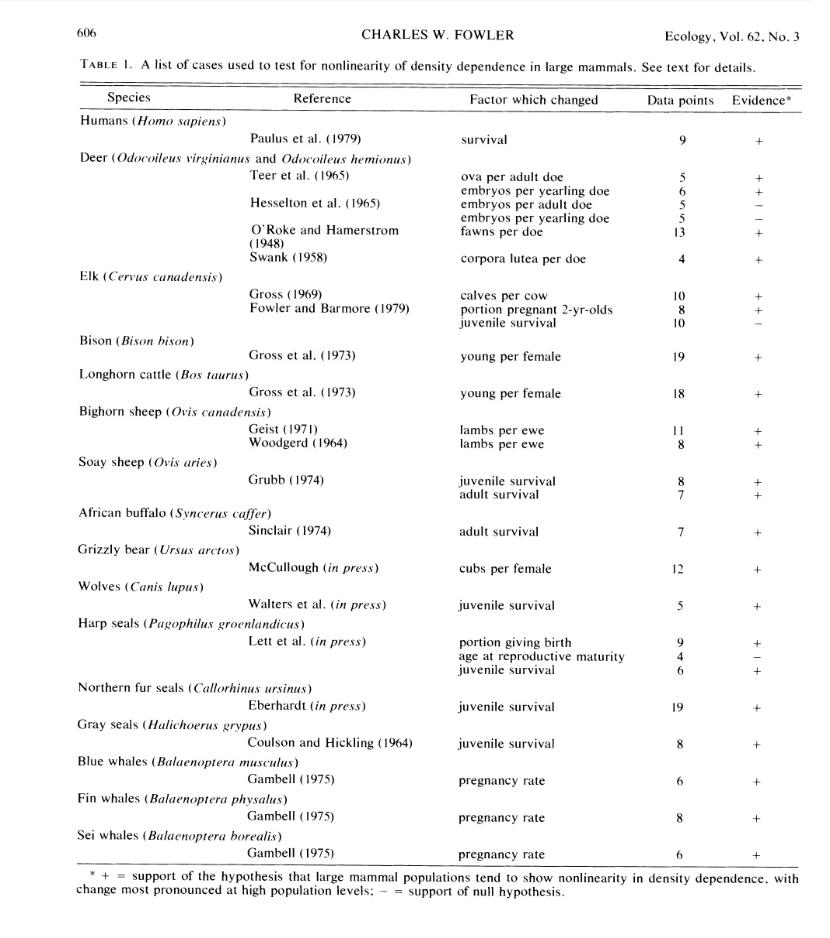
Fowler has generated a list of large animals for which there is strong evidence of density dependent birth rates. [16] He
places Man at the top of the list. Therefore, I wasn’t so bold after all when I converted density-dependent birth rates into a
law. This rule is pretty damned close to a law if not right on the money. If someone later discovers an exception to this rule,
it won’t take away from my argument. Such a finding would not debunk the theory that density-dependent fecundity is a law
for large mammals, specifically for the species I will be discussing in this site: Man. [17]
- ________________________________________________________________________________________
- Last modified 03/03/08
- Copyright © by Nila Gaede 2008

| Yesterday |
| Today |
Fig. 1 Balloon Ecology |
The relativists of Biology, Ecology, Economics, and Demography remain skeptical, especially on the sensitive issue of
choice. (How can you possibly say that a woman has no choice, Bill? Women's associations will burn you at the stake for
uttering such heresy!) The scholars claim that a woman has infinitely more options than an animal:
- “ carrying capacity is determined jointly by human choices and natural constraints…
Human choices about the Earth’s human carrying capacity are constrained by
facts of nature which we understand poorly. So any estimates of human carrying
capacity are only conditional on future human choices and natural events.” [19]
Bailey synthesizes a similar notion in his one-liner:
- “ Individuals, not populations, reproduce.” [20]
For example, an individual may decide to forego children despite having access to abundant resources, or she may think
that labor pains are not worth the trouble and use an IUD the next time, or she simply may not find the appropriate mate.
The number of variables is so great that it is impossible to predict what she is going to do. In other words, the analysts are
saying that we are smart, intelligent beings, but we have no idea what determines our carrying capacity.
Again, this shows that common sense is a very scarce commodity in the establishment. People like Cohen and Bailey are
being penny wise and pound foolish; they can’t see the forest for the trees. Perhaps we cannot predict what one buffalo
will decide to do, but we can certainly predict whether most of the individuals in the herd will stampede over the cliff. This
is what density-dependent birth rates are all about. They are predictable because they make allowances for behavioral
extremes.
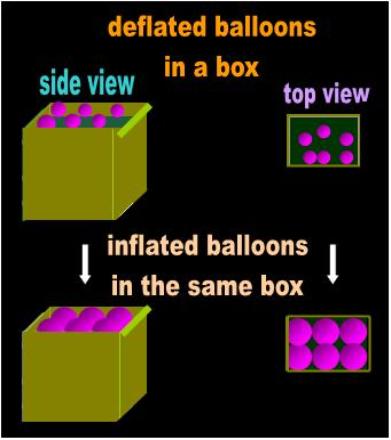
| A practical way to understand density- dependent birth rate is through the following analogy. Assume we have a box full of air-filled balloons. Each balloon represents the territory of a unit (individual, clan, pride, colony, etc.). The entire volume of the box represents the local or global carrying capacity in terms of food. The sphere of influence of each unit is inversely proportional to resource availability: the richer the territory, the smaller the average territory of each unit. Therefore, we can fit fewer balloons in a given box when the sphere of influence of each unit expands. The question that you should keep in the back of your mind now is: Why doesn't the box expand? |
| Urban women have no freedom to choose whether to have a baby |
| Adapted for the Internet from: Why God Doesn't Exist |
Module main page: The mechanism behind background extinctions
Pages in this module:
- 1. The three population curves
2. All species eventually conquer the invisible bugs that keep their numbers back
3. Not education, but urbanization causes infertility
4. This page: Urban women have no freedom to choose whether to have a baby
5. An urban woman doesn't have the privilege or need to have a family
6. Density is what overturns a pyramid
7. Urbanization was inevitable
I believe that what leads the researchers to be skeptical about density-dependent birth rates is the still nebulous definition
of carrying capacity. Are we talking about living space or food? Density is a word most people associate with space. Therefore,
most ecologists are thinking about elbow room rather than resources. For example, in a seminal experiment, Calhoun gave a
colony of rats ample food, allowed them to multiply, but kept the living space constant. The rats eventually changed their
behavior and succumbed to a significantly low level of ‘overcrowding’. It was the scarce living space that finally drove the rats
nuts and which led them to stop procreating. Although space and food may both play a role in the phenomenon of density-
dependent birth rates, in a natural setting migration relieves spatial pressure and it is food that remains as the ultimate
constraint. If we define density as the ratio of the numbers of individuals of a species to the supply of food, then all life is
subject to density-dependence birth rates.
4.0 How Mother Nature does it
How then does nature trigger these universal responses to population pressures? Are cows and dune plants that smart? Do
they take family planning classes from their mothers? Is there compulsive infertility imposed by the elders of the herds and
gardens?
Researchers have inferred certain conclusions from experiments and observations. Ross and Harper demonstrated that
plants which establish themselves first by growing faster in a densely sown area crowd out those that lag behind. The
late-comers are compelled to compete for leftover space and food resources. These plants grow to shorter lengths than
warranted by the time interval and dedicate a smaller proportion of their biomass to seeds. Likewise, Klein concludes:
Does any of this ring a bell?
Darwin’s theory of natural selection predicts a similar phenomenon for animals which are organized in a hierarchical or
pyramidal economic structure, which means all of them. Those that live in unproductive territories spend more time and
efforts searching for food, patrolling their territory, and fighting off rivals. A hungry tigress is a stressed animal more
concerned about her own survival than about gratifying her lover. Staying alive takes priority over reproduction. The Law
of Nature is: always business before pleasure! Hence, any changes in the density of the population as measured with
respect to resources will have an indirect effect on birth rates. Those that are wealthy enjoy the luxury of breeding. Those
that are poor may not. Territoriality (i.e., density in relation to resources) thus preempts surplus progeny by limiting the
number of parents (Fig. 1). There are ‘poor’ animals that nevertheless breed now and then despite their precarious situation,
mainly because they miscalculated or were caught off guard by subsequent events. In Southern’s study of owls, death-end
mechanisms included failure of eggs to develop and mortality in the nest. In Harcourt’s study of potato beetles, the
breakdown included cannibalism and starvation. In all hierarchical structures, the few are wealthy and the many are poor.
Serfs and proletariats tend to be a much larger segment of the population as resources dwindle. Hence, from a strictly
statistical point of view, as density increases and resources become scarcer, all these factors work together to limit global
reproduction.
Humans are not immune to density dependent birth rates; we are, after all, a hierarchical species. An urbanite living in
Bogota does not decide to abstain from having children because Shanghai is overcrowded. Her decision stems from
cultural and economic factors closer to home. The amount of wealth she possesses is not a measure of space, but a
measure of her personal finances. Her relation to resources, in turn, has an inordinate effect on her decision to have a
baby. This problem does not necessarily require that the woman go to the university to learn about planned-parenthood.
Like the tigress, a proletariat experiences the hardships of life directly, and her intuition directs her to shift priorities from
having a family to watching out for number one. Call it intuition or instinct or whatever. If she opts to have children in spite
of her precarious situation, Mother Nature has the option of claiming the surplus through disease, starvation, abortion, or
outright murder. So far our intelligent human had as many choices as the ‘dumb’ tigress.